Showing posts with label absinthe. Show all posts

Friday, May 30, 2014

Update on Absente Absinthe's misleading marketing


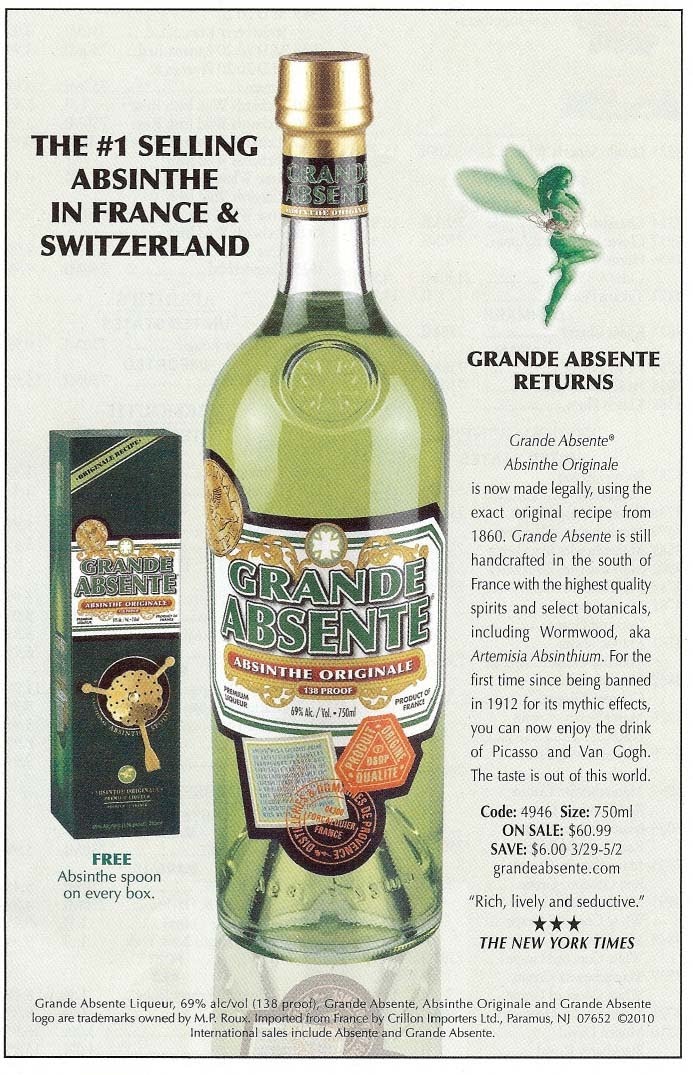
Three and a half years ago, I wrote this article about how Crillon Importers and their absinthe brands (most notably Absente) were misleading consumers.

It seems as though their tactics have continued unabated.  Since that original article was published, they have continued to market their brands as having the 'maximum amount of thujone allowed by law'.  While technically correct, it's also very misleading.  Let's examine why for posterity's sake:

  1. Thujone's effects have been outrageously exaggerated for many many years, even after being thoroughly debunked through scientific analysis.
  2. The U.S. legal limit for thujone is 10mg/l and the EU limit is 35mg/l.  Even assuming that their European offerings have 3.5 times the thujone limit of their US offerings, what they fail to mention is that both limits are considered THUJONE FREE.  So when they say they have the maximum amount allowable by law they are telling the truth. But they are also saying that they contain NO THUJONE.
  3. I also feel the need to object to their claims of containing the maximum amount.  Unless they are intentionally adding in more thujone to each batch to 'top it up' to the 10mg/l or 35mg/l limit, there is practically no way to keep it right at the limit through natural means.  Thujone levels in wormwood vary based on the time of year the wormwood is harvested and its terroir.  Further, each year the levels of thujone vary.  It would be impossible to maintain such a standard as to come it directly at the limit with each batch.  The only way this could happen is if they test each batch before sending it to the TTB, then adding thujone to it.  I very highly doubt that they would go to this length, as it would be cost prohibitive.
Fast forward to today.

On their Facebook page (which I am banned from posting to after the last article), they posted the following passage:


This post makes me laugh, as it pretty much invalidates what Crillon had been claiming for years.  By claiming that Artemisia Absinthium is the authenticating factor for absinthe, they are indirectly claiming that their previous version of Absente, which was on sale from the late 1990's up through 2008, was NOT absinthe, since it did not contain said botanical.  In essence, they have been misleading consumers for over a decade.

Further, the claims that it's the thujone that make their product so 'sublime' (their words), is falling back on the same misleading marketing that they've been using for years.

Let's also not forget that these brands contain sugar and artificial colorings, which would invalidate them from being authentic absinthe to begin with.  But this type of marketing is even more inexcusable.

Not only is the marketing irresponsible and misleading, one could also make a legal argument that it is going against the rules set forth by DISCUS (top of page 7) that state that no producer should make claims of the effects of any botanical unless expressly approved.  The TTB also regulates these types of claims.  On their website, it states:

Examples of advertising areas that TTB will review include, but are not limited to, the following: 
  • Statements that are false, misleading, or deceptive;
  • Misleading or false curative or therapeutic claims;
  • Specific health claims and health related statements.

How long are they going to continue this charade about thujone?  Only time will tell.  But this underscores the need for consumers to do their own research into what they are buying.

Caveat Emptor.

Monday, November 22, 2010

The problem(s) with Absente and their sister brands

I've made a lot of stink in the past year about Pernod and their misinformation campaign, but there are other brands that have been just as difficult to deal with, if not moreso, and whose advertizing campaigns have proven detrimental to the idea of informing today's absinthe consumer.

Case in point: Crillon Importers. Their products include Absente, Grande Absente, Absinthe Ordinaire and now Michel P. Roux Supreme Absinthe.


I had my first dealings with Crillon a few years ago when they sent me a bottle of Grande Absente to review. The product itself was billed as an authentic 18th century recipe; one that included grande wormwood, thus qualifying it as real absinthe. Well, suffice it to say, the product itself was middle of the road, at best: harsh star anise flavor and artificially colored. The spokesman I talked with over the phone was surprised to hear I didn't find it great, which should have told me something.

Over the next two years or so, I'd run across some of their marketing, which was for the most part, misleading and/or incorrect, but I didn't think much of it, since it didn't seem to be a very popular brand in the U.S.

Fast forward to a few weeks ago.

While surfing around on Facebook, I ran across a new fan page called 'Absinthe - The Green Movement'. While it seems to be putting itself out there as an absinthe resource, it is in fact run by Crillon as a main page for all four of their brands. Due to their marketing ventures, the page has quickly garnered more than 8,000 members, which in my estimation is more than any other absinthe brand. A shame to say the least.

As I began to read through a lot of the posts made by the brand reps, I couldn't believe my eyes. A large amount of what they were posting was blatantly false and/or misleading. I reluctantly 'liked' the page, solely to enable me to comment on their posts, and correct some of the information. Well, let's just say they didn't like that too much. They got defensive quite quickly, and within a week or so, suspended my priveleges to post, and erased my comments. Apparently, they prefer censorship to true education.

Because of the huge following the page now has, I felt it was important for me to call them out on a lot of their statements. So that's what this post will be about. I'm going to break it down into several sections: Brand, Irresponsible representation, Absinthe History, and the dreaded Thujone.

BRAND
1) In one advertisement, they claimed that their brands are the best selling brands in France and Switzerland.


Well, since we know that Switzerland has a law that prohibits artificially colored absinthes from being sold in their country, we know for a fact that their claim cannot be true, since all three of their original brands are all artificially colored.

2) In multiple ads and FB posts, their representatives claimed that their brands were now being made with Northern Wormwood, which they claim make it authentic. There are two possibilities here: 1) The reps are so uneducated that they don't know that Northern Wormwood is not the same thing as Grande Wormwood, or 2)They aren't really using Grande Wormwood and they accidentally tipped their hats. My guess is the former, but unless we are able to examine their herbs, we'll never know.


IRRESPONSIBLE REPRESENTATION
On multiple occasions, I've seen the brand reps commend or endorse practices that can be extremely dangerous and/or illegal. A couple of examples:

1) On their flikr page, they featured a bar which lights their absinthe on fire, then had the patron first huff the fumes, then down the shot. As I mentioned there, the brand might have a legal battle on their hands when someone burns their mucous membranes by inhaling strong, hot alcohol vapors.

2) On their FB page, they rebuked me for criticizing a gentleman who was bragging about passing out a homemade 'bathtub' absinthe. They fully supported his actions until I explained to them the seriousness of their endorsement. Not surprisingly, they pulled their comment soon after, yet still published another comment criticizing me for calling them out. Here is the passage:


Shortly after the exchange, all of the comments were removed, apparently after they realized what they were endorsing.


ABSINTHE/BRAND HISTORY
The reps are a total mess here. I wouldn't be surprised if they just make stuff up, or at the most, do a cursory google search before posting something. Some of the highlights:

1) Absinthe was a treatment for malaria (no, it wasn't)

2) They claim that Absente was the first absinthe available in the U.S. market since 1912, and was available years before any other brand. This is misleading because the original Absente did not contain wormwood (the herb that gives absinthe its name), thus can't be considered real absinthe by any rational argument.

3) They claim that their product comes closer to original absinthe recipes than the majority of products made in the U.S. or Europe. Yet, on their Absente page, they also claim that they don't know what absinthe tasted like back in 1915. Try as I might, I can't figure out how both statements can be true simultaneously.

4) On their Facebook page, they claim: "We are committed to providing our consumers with only the highest quality absinthes possible by adhering to the same ingredients and artisinal methods used in the mid 1800's through the turn of the century." Three things wrong with that:

  • during the height of absinthe's popularity in France, there was a identity standard, which regarded artificially colored absinthes as lower in quality than naturally colored products. Thus, they cannot be the 'highest quality'.
  • Same ingredients. We know that FD&C Blue wasn't created until 1896, and FD&C Yellow #5 not until 1949. So we know they aren't adhering to the same ingredients used in the mid 1800's.
  • I won't even go into the whole use of the term 'artisinal'.


THUJONE
Here is where I feel the most irritated. Mainly because they claim to be educating the public, but in reality, they are being complacent in leading consumers to believe that thujone is an important part of absinthe. I think they believe that if they truly make an effort to play down the importance of thujone, they will lose customers who are buying absinthe strictly because they think thujone is a drug or has some recreational potential.

Instead of telling the truth, which means letting people know that the legal limits of 10mg.l in the US and 35mg/l (for bitters) in the EU essentially means thujone free, i.e. NO THUJONE, they instead use their best marketing speak to say they contain the MAXIMUM amount allowed by law. While what they are saying is most definitely true, it also reenforces the belief that more thujone is desirable.


If they were truly interested in educating the public they could simply reference the recent studies that show that pre-ban absinthes, for the most part, didn't contain much thujone, contrary to previous assumptions.

But I think that might be just too much work for them. I think they'd prefer to retain those potential customers by luring them in with MAXIMUM thujone amounts.


So, in conclusion, looking at the facts, one can only conclude that Crillon and their brands care more for extravagant marketing than they do about creating a superior product. Why is it that so many of the firms that have the most available capital tend to skimp on the product?

If Crillon had any sense about them, they'd hire someone who actually has a large amount of experience with absinthe and its history to work with their marketing department.

Yours in absinthe,

Brian

Monday, February 22, 2010

Mixology Monday is All About Absinthe this week!


Thanks to Sonja at Thinking of Drinking for letting me know about this week's theme for Mixology Monday.


I'm submitting a cocktail that I worked on at the request of a dear friend of mine who wanted to have a cocktail made in her dearly departed cat's honor.


This wasn't designed to be a strong drink. I went more in the vein of a spritzer, or even something similar to a Pimm's Cup. It was designed to be tasty, complex and still refreshing.


So, without further ado, the Purring Schubie cocktail:
0.5 oz Meyer Lemon juice
0.5 oz absinthe (I used Leopold's for it's light, fruity aroma and flavor)
1 oz Sazerac rye
1 oz gin (Plymouth or Voyager)
4 oz dry ginger ale (preferably Fever Tree)
healthy dash of Angostura bitters


Combine all ingredients in a mixing glass with plenty of ice and stir until chilled. Split the mixture between two cocktail glasses. Lemon peel to garnish.


Another version calls for Green Chartreuse in replacement of the absinthe. It adds a more savory and peppery flavor and overall feel. I actually prefer it to the absinthe based one, but they are both tasty. Due to its spicier character, that version has been coined 'Schubie is pissed'.

Tuesday, December 15, 2009

A closer look at Pernod

As Pernod begins to revamp their current absinthe product (we'll talk more about that later) with a brand new website and a new label, they are making more and more claims about their 1805 distillery in France being the first absinthe distillery.


“In 1805, Henri-Louis Pernod partnered with Major Dubied to found Pernod Fils and the first commercial absinthe distillery."


A similar statement is also made on their label, again suggesting that the distillery in France was the first absinthe distillery.

Really? This doesn't match the information on Pernod's own website http://www.pernod.net/histoire/index.htm where it states:

"At the end of the 18th century, a man by the name of Major Dubied began distilling the elixir professionally. A few years later in 1805, his son-in-law, Henri-Louis Pernod, opened a distillery in France."
Collectors have located and posted a 1896 Maison Pernod Fils promotional booklet http://www.oxygenee.com/1896-Pernod-Fils-Translation.pdf which states:

"Little by little, however, thanks to its fragrance and pleasant taste, the elixir came to the attention of not only the sick, but to that of more and more fans, so that the recipe had already acquired monetary value when when Mr. Henri-Louis Pernod acquired it to exploit it commercially. This happened in 1797. It was at that time the first absinthe factory was built. The establishment was created under extremely modest conditions, even for Couvet; the building where the industry was born still exists; it measures eight meters long by four meters broad by four meters high. Subsequently enlarged, the factory was not long in becoming too small and, in 1805, Mr. Pernod not being able to satisfy demand by the French customers which had taken to his product with a marked favor, fixed upon Pontarlier as the place to avoid the high taxes levied by the tax department upon Swiss Absinthe."


In short, literature produced by Pernod in 1896 and on their internet site today contradicts the 1805 claim at the top of the article: Switzerland, and in particular, Couvet remain the birthplace of absinthe, despite Pernod's attempt to annex it! Not to mention the fact that the evidence above shows Pernod wasn't the 'creator' of absinthe.

Now let's move on to the marketing of the product and the product itself.

Having researched absinthe's history for years, I've run in to multiple accounts of the controversies surrounding absinthe, and its prohibition throughout much of the world in the early 1900s.

Many of the myths surrounding absinthe, such as its ability to case hallucinations were largely popularized during the 1990's, during the rise of 'Bohemian style' absinths, which bear no resemblance to the Belle Epoque products of France and Switzerland. Mentions of hallucinations during the Belle Epoque were in relation to end-stage alcoholic patients who were going through alcohol withdrawal in sanitariums, and were not directly related to absinthe consumption specifically.

However, on Pernod's website, this passage can be seen:


Why would a brand which was victimized by prohibitionist fears and competing interests during the Belle Epoque use the same information that was once used to bring about its demise? Has Pernod eschewed quality, integrity and truth in favor of a campaign that attracts a crowd that cut its teeth on Bohemian brands looking for the next high?

Well, why don't we take a look at the product itself? From Pernod's marketing material:

Pernod® Aux Plantes d'Absinthe Superieur is based on the original absinthe recipe and today returns to restore its reputation for quality and handcrafted excellence. This 136 proof spirit is distilled from three primary ingredients, Grande Wormwood, Fennel, and Star Anis producing a light green and hint of amber color with a dominant flavor of anis, balanced with wormwood and a citrusy finish.

Having tried samples of Pernod Fils from multiple bottles ranging from the late 1800's through its Spanish brands in the 1960s, the new product bears little resemblance to the original. In a sense, the above statement is true (you can base a recipe on something, but have it be completely different). But in the same sense, ALL absinthes are loosely based on the same original recipe.

Here are some comparisons.

1)Pernod Fils absinthe of the Belle Epoque was naturally colored by soaking herbs in the distillate and drawing out the chlorophyll. The new brand is artificially colored as noted on its label.

2)Pernod Fils absinthe of the Belle Epoque used a recipe with high quality wormwood. The new brand has a barely detectable wormwood flavor. What flavor is there doesn't speak to high quality herb choice.

3) Pernod Fils absinthe of the Belle Epoque had a flavor that was dominated by high quality green anise. The new brand has the telltale flavor and aroma of lower quality star anise. Which by the way, is SIGNIFICANTLY cheaper as well.

4) Pernod Fils absinthe of the Belle Epoque exudes quality and points to high quality base alcohol and herbs. The new brand does not. It would not surprise me in the slightest if I found out much of the flavor came from oils and extracts as opposed to distilled herbs.

5) During the Wormwood Society's first annual blind tasting event, held in September of 2009, Pernod absinthe scored 17th out of 22 brands. Below Pernod were Le Tourment Verte, Mata Hari, La Fee, Koruna and Green Fairy. Several of those aren't even considered absinthes by experienced drinkers. That doesn't point to quality.

Make no mistake. Pernod Fils was THE gold standard of absinthe during the Belle Epoque. I just wish they took the time to employ the same level of quality and care in their new brand. Especially since they advertise it as a product of high quality. It's extremely disappointing to see the direction the new product has taken. It's even more disappointing to see so many of their regional reps having little or no education regarding absinthe, its history and its preparation.

For reviews of Pernod absinthe, please check out the Wormwood Society's review page.

*Footnote: Calls and emails to Pernod to get their comments on the above have not been returned.

Tuesday, November 24, 2009

Absinthe Original - Don't Believe the Hype


Over the past 2 years or so, we've seen an amazing shift in much of the marketing surrounding absinthe.

While proponents of authentic absinthe have always maintained that properly distilled absinthe is low in thujone, and that absinthe doesn't cause any deliterious effects aside from that of normal alcohol, others had used carefuly crafted misinformation and preyed on the club crowd with promises of aphrodisiacs and hallucinations.

Many of the brands who were touting their high thujone content before absinthe was again legalized in the US coincidentally and quietly began removing claims of hallucinations and other wild effects from their promo material. Many of them blatantly changed the thujone information on their websites without an explanation. All of them just so happen to now fall below the legal limit in the US of 10 ppm of thujone. Funny that.

But even with so many companies changing around their lies (no, not telling the truth, just telling different lies) to make a quick buck, some have steadfastly held on to their mantra of "drink now, ask why the effects didn't happen later."

Enter the promotional material I received from Absinthe Original today via email. Here's what they had to say about their product:


The so-called absinthe available in the U.S. contains no thujone, the psychoactive element that gives real absinthe its kick. Other absinthe manufacturers, (particularly those selling in the US), are so scared at the stigma of thujone that they decide not to use wormwood in their beverages. Yet, without wormwood, many wouldn’t consider liquor a true absinthe. Such reasoning is appropriate, especially considering the fact that real absinthe is derived from wormwood’s scientific name, Artemisia Absinthium.
However, our range of REAL ABSINTHE ORIGINAL is made from 100% wormwood, so you can be assured you’ll be getting the real thing if you decide to order securely and safely online.


So, in response, I've put together some educational information for those of you out there still wondering whether there really is something to all of the hype doled out by unscrupulous marketers such as those above. Let's dissect the above paragraph:

The so-called absinthe available in the U.S. contains no thujone, the psychoactive element that gives real absinthe its kick. - While it is indeed true that the U.S. has a legal limit of 10 ppm of thujone, this sentence is still very misleading.

  1. Thujone is not a recreational drug. Thujone does not provide any enjoyable effects. In high enough levels, thujone can cause renal failure and seizures, but I wouldn't consider that desireable.
  2. The term 'real' absinthe should refer to what was being consumed during the height of absinthe's popularity in the Belle Epoque. That being the case, Absinthe Original doesn't posess the qualities of 'real' absinthe.
  3. 'Real' absinthe of the Belle Epoque did not have high levels of thujone, contrary to what antiquated scientific theories hypothesized. The most recent studies have shown that many Belle Epoque absinthes had thujone levels that fell BELOW the legal US limits! Almost all of those that were analyzed fell below the EU legal limit of 35 ppm.
  4. Many absinthes that claim to have high thujone levels in fact have very little if any thujone, according to EU analysis of many online brands.

Other absinthe manufacturers, (particularly those selling in the US), are so scared at the stigma of thujone that they decide not to use wormwood in their beverages. - This is patently false. There is only one brand in the US that has decided to use something other than the traditional wormwood (Artimisia Absinthium): Absente. They began using Southern Wormwood (Artimisia Abrotanum). All other brands (that I'm aware of) that have been produced and/or sold in the US since 2007's legalization utilize authentic Artimisia Absinthium.

Yet, without wormwood, many wouldn’t consider liquor a true absinthe. Such reasoning is appropriate, especially considering the fact that real absinthe is derived from wormwood’s scientific name, Artemisia Absinthium. - Absolutely true. The Wormwood Society does not recognize Absente as an absinthe.

However, our range of REAL ABSINTHE ORIGINAL is made from 100% wormwood, so you can be assured you’ll be getting the real thing if you decide to order securely and safely online. - If you're looking for the 'real thing', the spirit that was consumed during the Belle Epoque, Absinthe Original isn't it. Feel free to view the Wormwood Society's review. And if the product is made from 100% wormwood, then that technically (I'm nitpicking here, I know) would mean that they don't use any other herbs, thereby making this a Wormwood Bitters, NOT an absinthe.

Lastly, levels of thujone do not indicate quality of absinthe. There is absolutely no evidence to point to any mention of thujone levels in Belle Epoque advertizing of absinthe. It wasn't a factor. It only became popular during the 1990's when brands such as Absinthe Original began to hype it as a way to drive sales to club goers.

As a parting gift, I leave you with a passage from the Lancet, published in 1868 in response to the original assertions that Absinthe itself deliterious effects:


“For our own part, we have never been convinced that there is anything in the symptoms of acute or chronic absinthism as they are described, essentially different from those of acute or chronic alcoholism which has been produced by the imbibition of innumerable drams of any spirit.
We have repeatedly seen the whole train of symptoms, which are now so much talked of, produced by the constant drinking of brandy or rum. As for hallucinations, there is nothing more common. At any rate, it will take a good deal of very solid and precise evidence to convince us that the trifling amount of essence of wormwood contained in the liquor called absinthe, adds any considerable poisonous power to the natural influence of some 20 or 30 ounces per diem of a highly concentrated alcohol.”


- “Absinthe,” The Lancet, Volume 91, Issue 2332, 8 May, 1868


Friday, April 17, 2009

Absinthe Tasting with Gary Vaynerchuck

So, here it is! After working on this for close to a year, we finally found a date that would work for both of us. Click below to be taken to the WS site where you can view the video (30 min.).


Here's the back story:

I've been watching Gary do wine tastings on his site, WineLibraryTV.com for quite a while now. I've always enjoyed his high energy, no pretense approach to wine. It brings it out of the stuffy shadows and snobbery that a lot of people equate with wine specialists. If you didn't know, his show is available on iTunes, so it can be automatically downloaded each day.

Anyway, back in July of last year, I was surprised to see an episode of Scotch pop up, and I got to thinking: if he is branching out and doing other things, he'd probably be interested in trying an absinthe episode.

I emailed him the next day, explaining to him who I am and a little about absinthe. I told him that in many ways, I liken absinthe to wine, in that after it's properly diluted, it has the same relative strength, and just as much depth of flavor.

I heard back within the day, with Gary saying he loved the idea! Planning the date proved to be harder than anticipated, but we finally nailed it down about two months ago.

All in all, it was a great experience. My only disapointment was that we were forced to cut out one of the brands I brought due to time constraints. Sorry to Marc Bernhard and his wonderful absinthe, Pacifique. I didn't have a choice in the matter.

Sunday, March 29, 2009

Latest Absinthe Tasting

It's been too long since I last updated the blog, but I've been overwhelmed with projects, both in my real job, and outside of it. Since noone here cares about my finance stories, I'll totally skip over that and update you instead on everything else!

1) Big news on the absinthe education front. I've enlisted the help of several Wormwood Society members to contribute to an upcoming absinthe feature in a prominant magazine. It will be both the cover story and also an 8+ page spread. It should be great! I'll hold off on announcing which publication until everything is finalized.

2) I'll be visiting with Gary 'Vay-ner-CHUCK' on WineLibraryTV to go over several brands of absinthe that are now available in the US. We tape on April 8th. I'll post airing info as it becomes available.

3) The latest date for the TasteDC Absinthe Tasting event has been set for May 14th again at the Chi Cha Lounge in NW DC. I believe the house absinthes will still be featured (Kubler, Lucid and Pernod) as well as several others that I've been able to procure, which at this point will probably be Marteau, Leopold Brothers and Obsello with a potential showing of Pacifique. The last event went fabulously, although I did have some trip ups with the history presentation. I'd tried to throw too much into too little time and it got a little sloppy. This time it should go much more smoothly, since I know exactly how much time I have.

4) Posted a point/counterpoint article regarding some new 'absinth' (notice there's no 'e') products coming to the U.S. market over on The Real Absinthe Blog.

Upcoming entries:
1) A post about the last absinthe tasting event
2) Another Scotch tasting event recap
3) A roundup of the WineLibraryTV taping

See you around!

Tuesday, March 10, 2009

My empire expands!

OK, that's overdoing it. But in either case, I'm happy to announce that I have been asked to become a co-author of Alan Moss' baby, the Real Absinthe Blog!

I'm excited to be part of such an active resource. I think it will fit well as a companion to the Wormwood Society, as each focuses on separate yet related issues. The Wormwood Society's main page focuses mainly on educational resources, while the RAB focuses more on current events and interviews. Both are sorely needed during this all-too-important time of absinthe's infancy in the U.S. market, where as much TRUE information as possible is required to see absinthe become a staple in every bar. We'll also be working towards the goal of separating inherent product interests from unbiased information.

Further, I feel it will help to bring to fruition our goal of providing a Wormwood Society e-zine. While it's not at the forefront of most agendas right now, I think it will be an indispensible addition once it gets off the ground.

Thanks to Alan Moss for his consideration. I'm looking forward to the blog's continued success!