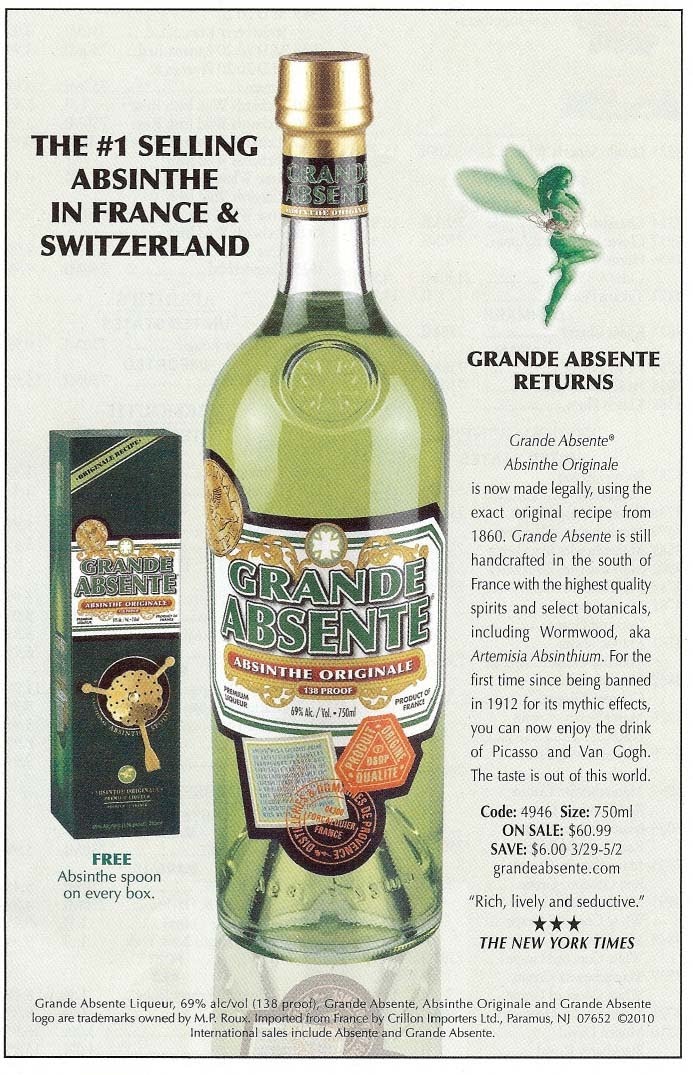
Three and a half years ago, I wrote this article about how Crillon Importers and their absinthe brands (most notably Absente) were misleading consumers.
It seems as though their tactics have continued unabated. Since that original article was published, they have continued to market their brands as having the 'maximum amount of thujone allowed by law'. While technically correct, it's also very misleading. Let's examine why for posterity's sake:
- Thujone's effects have been outrageously exaggerated for many many years, even after being thoroughly debunked through scientific analysis.
- The U.S. legal limit for thujone is 10mg/l and the EU limit is 35mg/l. Even assuming that their European offerings have 3.5 times the thujone limit of their US offerings, what they fail to mention is that both limits are considered THUJONE FREE. So when they say they have the maximum amount allowable by law they are telling the truth. But they are also saying that they contain NO THUJONE.
- I also feel the need to object to their claims of containing the maximum amount. Unless they are intentionally adding in more thujone to each batch to 'top it up' to the 10mg/l or 35mg/l limit, there is practically no way to keep it right at the limit through natural means. Thujone levels in wormwood vary based on the time of year the wormwood is harvested and its terroir. Further, each year the levels of thujone vary. It would be impossible to maintain such a standard as to come it directly at the limit with each batch. The only way this could happen is if they test each batch before sending it to the TTB, then adding thujone to it. I very highly doubt that they would go to this length, as it would be cost prohibitive.
Fast forward to today.
On their Facebook page (which I am banned from posting to after the last article), they posted the following passage:

This post makes me laugh, as it pretty much invalidates what Crillon had been claiming for years. By claiming that Artemisia Absinthium is the authenticating factor for absinthe, they are indirectly claiming that their previous version of Absente, which was on sale from the late 1990's up through 2008, was NOT absinthe, since it did not contain said botanical. In essence, they have been misleading consumers for over a decade.
Further, the claims that it's the thujone that make their product so 'sublime' (their words), is falling back on the same misleading marketing that they've been using for years.
Let's also not forget that these brands contain sugar and artificial colorings, which would invalidate them from being authentic absinthe to begin with. But this type of marketing is even more inexcusable.
Not only is the marketing irresponsible and misleading, one could also make a legal argument that it is going against the rules set forth by DISCUS (top of page 7) that state that no producer should make claims of the effects of any botanical unless expressly approved. The TTB also regulates these types of claims. On their website, it states:
Not only is the marketing irresponsible and misleading, one could also make a legal argument that it is going against the rules set forth by DISCUS (top of page 7) that state that no producer should make claims of the effects of any botanical unless expressly approved. The TTB also regulates these types of claims. On their website, it states:
Examples of advertising areas that TTB will review include, but are not limited to, the following:
- Statements that are false, misleading, or deceptive;
- Misleading or false curative or therapeutic claims;
- Specific health claims and health related statements.
How long are they going to continue this charade about thujone? Only time will tell. But this underscores the need for consumers to do their own research into what they are buying.
Caveat Emptor.